Definition
An octave refers to the interval between one frequency and its double
or its half. There is one octave band between frequencies 1 000 Hz and
2 000 Hz. There is another one octave band between 1 000 Hz and 500 Hz.
In music, an octave is the frequency band contained between one
"do" and the first lower or higher one.
In Engineering applications, the sound source spectrums are usually represented in octave or one-third octave frequency bands rather than in narrow frequency bands. This frequency representation is linked to the perception of sound by a human ear and allow a compression of the amount of information. An important part of the information is however lost when converting results from narrow frequency bands to octave or one-third octave frequency bands.
Each octave and 1/3 octave bands are identified by middle frequency $f_{0}$ and a lower and a higher frequency bounds defined as:
| Octave | 1/3 octave | |
|---|---|---|
| Middle frequency | $f_{0}$ | $f_{0}$ |
| Minimum frequency | $f_{0}/2^{1/2}$ | $f_{0}/(2^{1/2})^{1/3}=f_{0}/2^{1/6}$ |
| Maximum frequency | $f_{0}\times 2^{1/2}$ | $f_{0}\times(2^{1/2})^{1/3}=f_{0}\times 2^{1/6}$ |
Example
Table below summarized the octave and the 1/3 octave middle frequencies and bands computed from expressions reported in the table above.
| Octave freq. | Octave band | 1/3 octave freq. | 1/3 octave band |
|---|---|---|---|
| 16 | 11.3 - 22.6 | 16 | 14.3 - 18.0 |
| 20 | 17.8 - 22.4 | ||
| 25 | 22.3 - 28.1 | ||
| 31.5 | 22.3 - 44.5 | 31.5 | 28.1 - 35.4 |
| 40 | 35.6 - 44.9 | ||
| 50 | 44.5 - 56.1 | ||
| 63 | 44.5 - 89.1 | 63 | 56.1 - 70.7 |
| 80 | 71.3 - 89.8 | ||
| 100 | 89.1 - 112.2 | ||
| 125 | 88.4 - 176.8 | 125 | 111.4 - 140.3 |
| 160 | 142.5 - 180.0 | ||
| 200 | 178.2 - 224.5 | ||
| 250 | 176.8 - 353.6 | 250 | 222.7 - 280.6 |
| 315 | 280.6 - 353.6 | ||
| 400 | 356.4 - 449.0 | ||
| 500 | 353.6 - 707.1 | 500 | 445.4 - 561.2 |
| 630 | 561.3 - 707.2 | ||
| 800 | 712.7 - 898.0 | ||
| 1 000 | 707.1 - 1 414.2 | 1 000 | 890.9 - 1 122.5 |
| 1 250 | 1 113.6 - 1 403.1 | ||
| 1 600 | 1 425.4 - 1 795.9 | ||
| 2 000 | 1 412.2 - 2 828.4 | 2 000 | 1 781.8 - 2 244.9 |
| 2 500 | 2 227.2 - 2 806.2 | ||
| 3 150 | 2 806.3 - 3 535.8 | ||
| 4 000 | 2 828.4 - 5 656.9 | 4 000 | 3 563.6 - 4 489.8 |
| 5 000 | 4 454.5 - 5 612.3 | ||
| 6 300 | 5 612.7 - 7 071.5 | ||
| 8 000 | 5 656.9 - 11 313.7 | 8 000 | 7 127.2 - 8 979.7 |
| 10 000 | 8 909.0 - 11 224.6 | ||
| 12 500 | 11 136.2 - 14 030.8 | ||
| 16 000 | 11 313.7 - 22 627.4 | 16 000 | 14 254.4 - 17 959.4 |
| 20 000 | 17 818.0 - 22 449.2 |
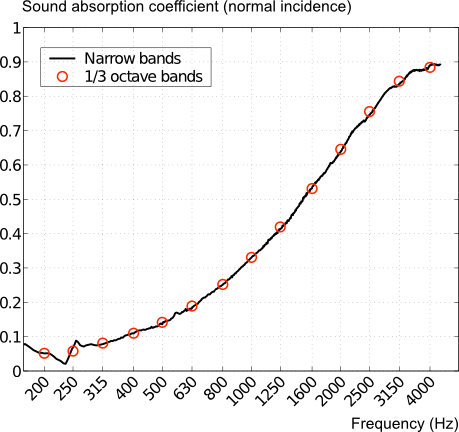
The above figure represents the conversion from narrow frequency bands
within the range [200 - 4 000] Hz to one-third
octave frequency bands for the sound absorption coefficient of a
30 mm-thick fibrous material measured at normal incidence in a standing wave tube.
The values of the sound absorption coefficient included in
a 1/3 octave band are averaged; the obtained mean value of the sound
absorption coefficient is then reported at the 1/3 octave middle
frequency.