References
The references used in this page are reported hereafter.
[ZK49] Zwikker C. and Kosten C. W., Sound absorbing materials, Elsevier, New-York, 1949.
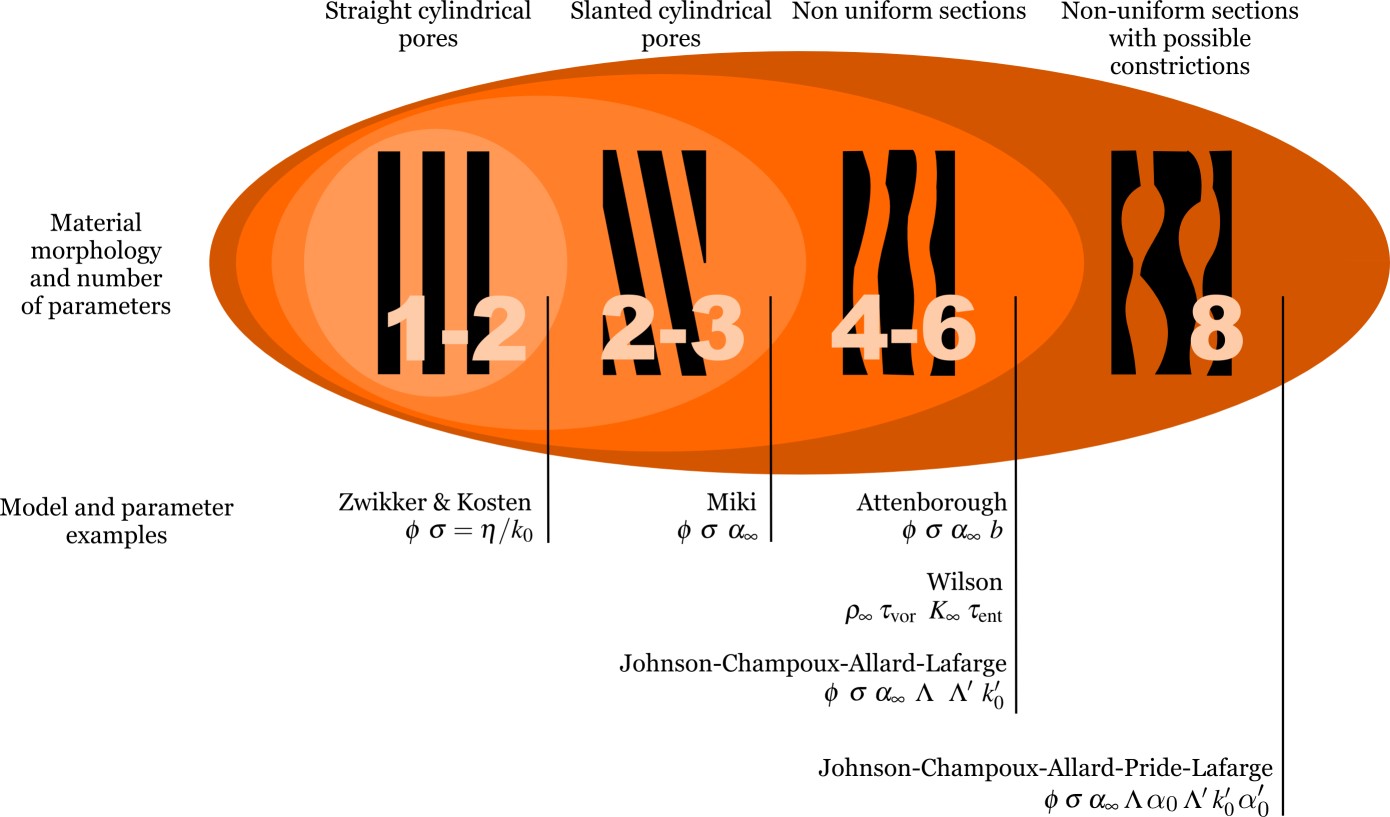
[Att83] Attenborough K. Acoustical characteristics of rigid fibrous absorbents and granular materials, J. Acoust. Soc. Am. 73(3), pp.785–799, 1983.
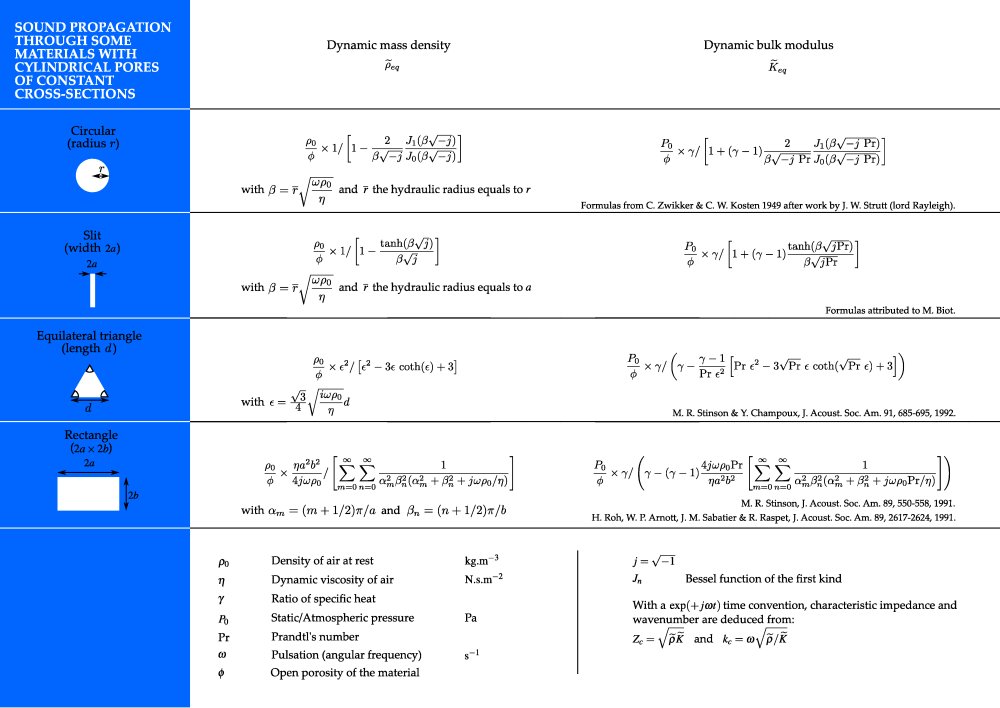
[Sti91] Stinson M. R., The propagation of plane sound waves in narrow and wide circular tubes, and generalization to uniform tubes of arbitrary cross-sectional shape, J. Acoust. Soc. Am. 89(2), 1991, pp. 550-558 ■
[DB70] Delany M. E. and Bazley E. N., Acoustical properties of fibrous absorbent materials, Applied Acoustics 3, 1970, pp. 105-116 ■
[Mik90a] Miki Y., Acoustical properties of porous materials - Modifications of Delany-Bazley models, J. Acoust. Soc. Jpn (E). 11(1), 1990, pp. 19-24 ■
[Mik90b] Miki Y., Acoustical properties of porous materials - Generalizations of empirical models,
J. Acoust. Soc. Jpn (E). 11(1), 1990, pp. 25-28 ■
[HGD16] K. V. Horoshenkov, J.-P. Groby, O. Dazel,Asymptotic limits of some models for sound propagation in porous media and the assignment of the pore characteristic lengths, J. Acoust. Soc. Am. 139 (5), 2016, pp. 2463–2474.
[HHG19] K. V. Horoshenkov, A. Hurrell, J.-P. Groby, A three-parameter analytical model for the acoustical properties of porous media J. Acoust. Soc. Am. 145 (4), 2019, pp. 2512–2517.
[Wil93] Wilson D. K., Relaxation-matched modeling of propagation through porous media, including fractal pore structure, J. Acoust. Soc. Am. 94(2), 1993, pp. 1136-1145 ■
[JKD87] Johnson D. L., Koplik J. and Dashen R., Theory of dynamic permeability and tortuosity in fluid-saturated porous media, J. Fluid Mech. 176, 1987, pp. 379-402 ■
[CA91] Champoux Y. and Allard J.-F., Dynamic tortuosity and bulk modulus in air-saturated porous media, J. Appl. Phys. 70, 1991, pp. 1975-1979 ■
[LLAT97] Lafarge D., Lemarinier P., Allard J.-F. and Tarnow V., Dynamic compressibility of air in porous structures at audible frequencies, J. Acoust. Soc. Am. 102(4), 1997, pp. 1995-2006 ■